
INFRASTRUCTURE VS HUMAN CAPITAL
Tanzania faces a profound philosophical choice as it charts its path toward the year 2050: whether to prioritise the development of its people or the infrastructure that sustains them.
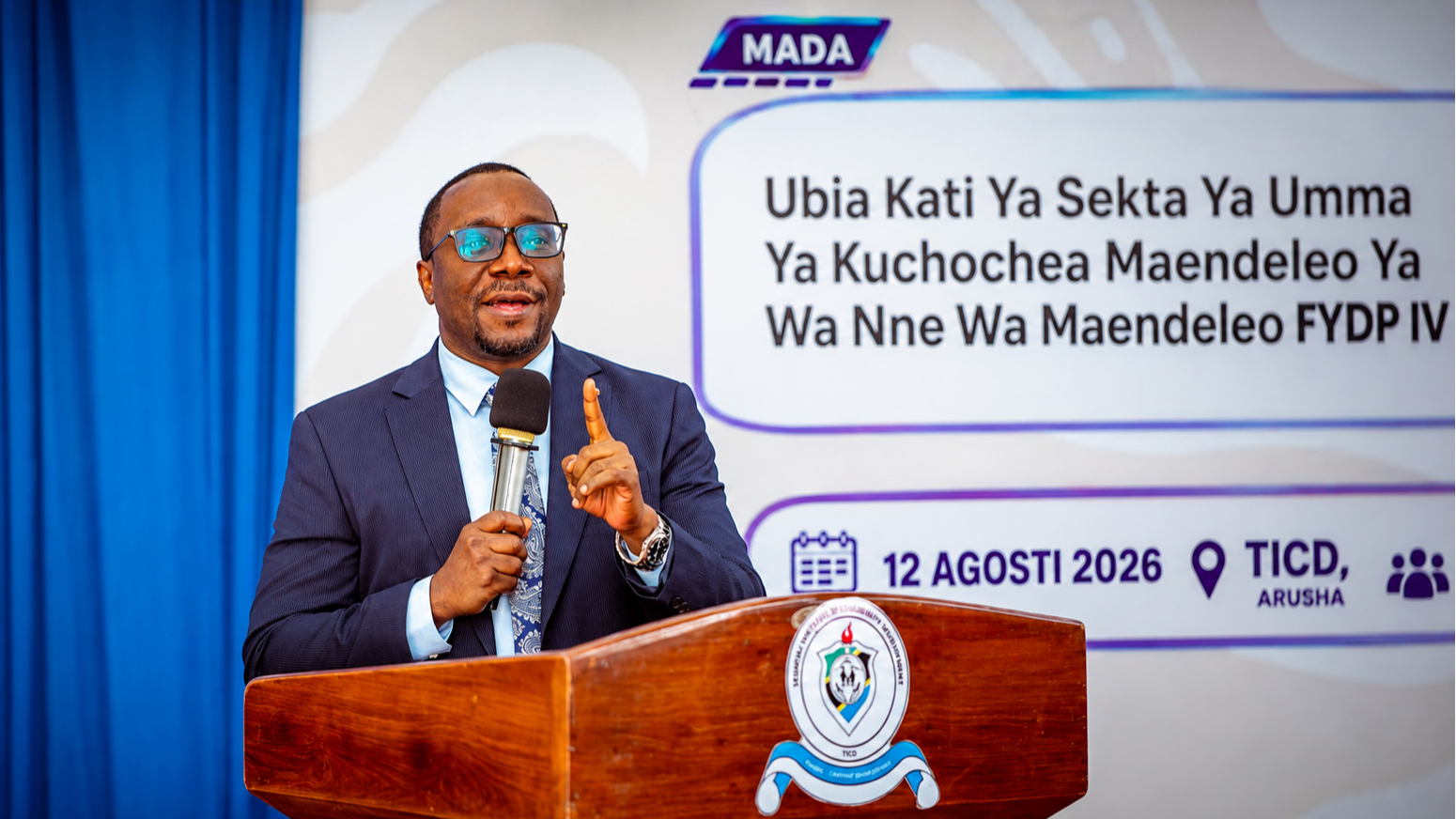
The dilemma was unveiled on Friday, August 14, 2026, during a high-profile public lecture held at the Tengeru Institute of Community Development.
The event was organised by the Public-Private Partnership Centre (PPPC) in collaboration with the TCID, themed: Public-Private Partnerships as a Catalyst for Development and Opportunities in the Fourth Five Year Development Plan (FYDP IV) and Vision 2050.
Presiding over the lecture, PPPC executive director, Mr David Kafulila, warned that failing to strike the right balance could leave the nation ‘sharing poverty’ rather than building prosperity.
“If we do not act, we will simply be sharing poverty,” Mr Kafulila told an audience of students, lecturers, and local officials.
“Investing in infrastructure increases production. If you increase production, you increase tax revenue, you increase employment, and you increase income. You can then bring about the development of the people,” he added.
Mr Kafulila framed the central debate of the era as a dilemma between ‘people’ and ‘things’.
While acknowledging that investing in human capital makes individuals more productive, he argued that infrastructure development is the primary engine that drives production.
He questioned whether the nation should prioritise budgets for education, water, and health over electricity and roads, but concluded that high standards of human quality can only be reached through a base of capital and production.
To resolve this dilemma, Mr Kafulila referenced studies suggesting a necessary balance of 60 percent investment in human capital and 40 percent in infrastructure.
He warned against a model where tax revenue is spent primarily on government salaries without increasing production, a practice he likened to a nation ‘eating its seeds.’
“Knowledge is the global currency,” Mr Kafulila stated, noting that nations are ranked by the quality of their people rather than their natural resources.
He aimed to raise the national Human Capital Index from the current 40 percent to between 65 and 70 percent by 2050.
A critical component of this strategy is the ‘Prosperity Pivot,’ which recognizes that the 2050 Vision requires moving away from state-dependent models toward a production-led economy powered by the private sector.
This transformation demands a ‘smaller government’ focused on policy and regulation, while a ‘larger’ private sector and civil society drive welfare.
“When the government is small and the private sector is large, the debate about delayed salaries disappears,” said Mr Kafulila, illustrating this with a story of his childhood village where the entire economy revolved around the government paymaster's arrival.
By fostering a large private sector, the welfare of citizens is no longer tied solely to the state's budget.
This economic evolution must be inclusive, which Mr Kafulila defined as prioritising the advancement of women, noting that women comprise 70 percent of the workforce in agriculture and the small-to-medium enterprise (SME) sector.
“When policy makers talk about inclusivity, they are looking at carrying the woman. If she is supported, the economy becomes inclusive,” he explained.
“Studies show that 90 percent of a woman's income is used for the family, whereas for men it is 35 percent. By helping the woman, you have helped the development of the family,” added Mr Kafulila.
The roadmap also focuses on transitioning Tanzania’s youth from being ‘liabilities’ to becoming ‘assets’ on the national balance sheet.
With one-third of the global workforce expected to be in Africa by 2050, Mr Kafulila stressed that quality skills are more important than academic certificates.
He cited a World Bank study showing that a youth with vocational skills can have 15 times the economic impact of a non-productive degree holder.
Furthermore, he warned that 85 percent of the jobs that will exist in 2050 have not been created yet.
To compete in the age of Artificial Intelligence, Mr Kafulila urged students to master a ‘Global Triad’ of diligence, knowledge, and integrity.
“Integrity builds your value because it builds trust. You can be hired even if you have less knowledge because you are trusted. But if you have knowledge without integrity, you will fail,” he said.
Finally, to cut national poverty by half, the agricultural sector requires an annual growth rate of eight to 10 percent.
This requires a massive $20-billion investment in irrigation for three million hectares by 2030.
Mr Kafulila stressed that this sum is impossible for the government to provide alone, making private sector participation through public-private partnership (PPPs) a necessity to implement projects ‘off the balance sheet’ and avoid increasing the national debt.
Addressing the ‘managerial efficiency gap,’ he noted that top economic nations derive 25 percent of their wealth from institutional efficiency, while in Africa, this figure often sits at a mere five percent.
By using PPPs to recruit ‘top-tier’ management talent, likened to football stars, Tanzania can reduce public sector inefficiencies and win the ‘one-trillion-dollar marathon.’
TICD acting deputy director (Planning, Finance and Administration), Ms Janeth Zemba, said the institute has included public-private-partnership (PPPs) in its curriculum.
She said the decision was taken to ensure graduates entering the job market have the ability to link the public and private sectors with citizens at various levels of development.
“Following these improvements, TICD programmes now enable students to understand how to prepare viable project proposals and attract local and foreign investors,” said Ms Zemba.
She said the investment in training also seeks to support efforts by President Samia Suluhu Hassan to strengthen the private sector as an engine of economic growth.
Ms Zemba stressed that teaching the modules is in line with the country’s direction towards the National Development Vision 2050, under which many social and infrastructure projects are expected to be implemented through strategic partnerships rather than relying solely on the government budget.
“We have taken this step to support efforts by the government, led by President Samia Suluhu Hassan, to strengthen the use of partnerships as an important tool for accelerating social and economic development alongside implementation of the National Development Vision 2050,” she said.